
Data Centers: The Secret Invasion

Yes or No To Data Centers?
Published in Western Standard
It appears that North America is fiercely divided on the subject of data centers being located on our soil. As is unusual in our two countries, both Canada and the United States are at worst adamant and at best ambivalent regarding the invasion of these behemoths. A necessary evil or additional overreach?
Dead Wildlife and MUCH Higher Utility Bills
Even the infamous Erin Brockovich has thrown her hat in the ring and entered the fray in full battle mode. According to The Guardian, this thirty year veteran of legal battles against big corporations, in the name of progress, and the mindless poisoning of our pristine countries and their inhabitants is armed and ready for battle.
Upon receiving thirty emails from residents of a small US town complaining about data centers, Ms. Brockovich put out a call on her website for like-minded citizens. Immediately she received 3862 responses. One of these reported their water bill increased in one month, after installation of the nearby data center, from $22.00 to over $350.00.
Other responders reported wildlife disappearing and animals laying dead in unlikely places. Bulldozers arriving before any public notice or discussion. NDA,s signed by their own elected officials, effectively preventing them from warning their constituents. One very pertinent question was put forth: ‘If data centers are so great, why are they being built in secret?’
More than 200 environmental groups demand halt to new US data centers
Also reported by The Guardian, two thirds of the US data centers are erected in drought stricken areas. They require up to five million gallons of water per day, equivalent to average usage of fifty thousand people. Let that sink in.
A campaign opposing the construction of a data center in Nashville, Tennessee, in close proximity to the Nashville Zoo, has surged past 400,000 signatures, due in part to the support from country singer Brad Paisley. He commented, “First of all they don’t have the power to build this. They don’t have the water. It doesn’t belong there. It would be an enormous monstrosity, an absolute eyesore, and detract in every way from the zoo and surrounding area.” This zoo, which received 1.4 million visitors last year and is home to 3700 animals, was described by Paisley as “one of the top zoos in the world.” The zoo stated emphatically that there is a definite lack of publicly available studies assessing potential harm.
The Dangers of Living Near These Centers
 As Mark Carney pushes AI and digital sovereignty vehemently to further his own devious agenda, there are both pros and cons to be considered, in spite of his tunnel vision. From soaring energy bills to huge environmental impacts, there are serious downsides to being neighbors to one of these projects. Electricity grid strain, excessive water consumption, constant noise both day and night, and air pollution, to name a few.
Often AI centers are erected on rural sites due to lower power grid demand. This entails massive clear cutting and site preparation, permanently altering forested and undeveloped land by the hundreds of acres.
The promised economic benefits are often gravely overstated. In short, data centers rarely improve local economies, as often stated. Property values are in upheaval, insurance premiums rise, and often homeowner displacement, whether singly or entire residential areas, are unavoidable.
Chinese Regime Infiltrating Canada
The federal government issued this statement: “Canada will double the electricity grid, largely with clean power, hydro, nuclear and renewables, and leverage its cold climate to give itself a built-in cost advantage that competitors are spending billions to replicate artificially while minimizing carbon footprint and water usage. (Sound like more Carney word salad?)
“New projects must meet strong environmental standards, use energy and water responsibly, deliver tangible benefits to local communities, and ensure taxpayers are not left bearing unreasonable costs for private development.” Ha. That would be after Carney gets his cut, of course.
Why Is Alberta a Choice Location?
There has been a definite change regarding these structures in Canada. The ones currently being built have ten times the capacity of the previous ones. There are five hyperscale data centers at this time – two in B.C. and the other three in Ontario, Quebec, and New Brunswick. Currently an additional ninety-six are either under construction or planned for the near future.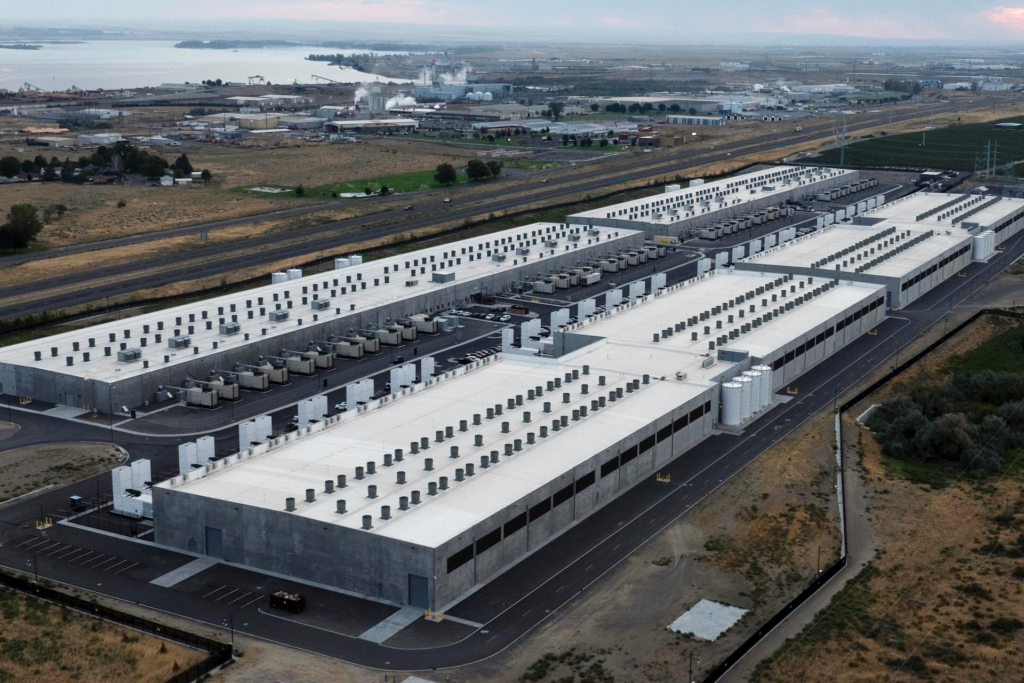
Alberta is the preferred location with such advantages as fiber optic network, skilled workforce, and the provincial government making it clear that they are open for business. Once again the lure of dollars over any other considerations. As well their deregulated electric system and cheap natural gas are attracting the center builders.
To quote Byron Hackett, Managing Editor of the Red Deer Advocate, “Here we are on the heels of a $13 billion investment in our province from Meta. The numbers sound great to most Albertans:
- project will create more than 3000 construction jobs and support 300 operational jobs
- generate approximately $250 million annually in benefits for Albertans.
- Meta is also investing approximately $60 million in local infrastructure improvements
But at what cost? There is no question that Meta plunked its data center in Sturgeon County, north of Edmonton, because the Alberta government relaxed regulations and the regulatory environment to pave the way for it.
10 Times the Power Required than a Google Inquiry
The one gigawatt center will draw as much power as the entire city of Edmonton. Research has shown that on average, a ChatGPT query needs nearly ten times as much electricity to process as a Google search.”
To be fair, data center developers are attempting to find more efficient use of water by using a closed-loop system similar to a car radiator. This, in my opinion, is a drop in the bucket, no pun intended. Some are investing in off grid power generation. I suppose you could call that a step in the right direction.
I am not opposed to progress in any way, but I am opposed to the further destruction of our continent and the further stripping away of our people’s financial security and quality of life.
Are Canadian Indigenous Leaders Just More Crooked Politicians?